The generator, the critics and the game between them
Every model in this study shares one generator — a 7.76 M-parameter 2D U-Net. What changes between runs is the network sitting opposite it: its kernel size, its stride, its downsampling strategy, and how much of a slice one verdict is allowed to cover.
2D U-Net — encoder, bottleneck, decoder
Four pooling levels, doubling filters on the way down and halving on the way up, with a skip connection at every level so the decoder can recover the spatial detail that pooling destroyed.
padding='same', ReLU and
he_normal initialisation. Only the bottleneck carries dropout. Skip connections are
channel-axis concatenations, so the decoder convolution that follows sees both the upsampled
semantic features and the high-resolution encoder features.Design decisions, and what they cost
| Choice | Reason | Trade-off accepted |
|---|---|---|
| 2D, not 3D | 3D activations plus a discriminator exceed the available GPU memory | no inter-slice context |
| 128×128 input | power of two divides evenly through four pooling levels | detail lost on the small necrotic core |
| 2 channels, not 4 | T1ce and FLAIR carry near-complementary information | T1 and T2 residual signal discarded |
| 32→512 filters | half the width of the original U-Net; fits one patient per step | lower capacity than a full-width model |
| Dropout only at the bottleneck | regularise the widest layer without disturbing skip features | encoder can overfit |
UpSampling2D + Conv | avoids the checkerboard artefacts of transposed convolution | no learned upsampling kernel |
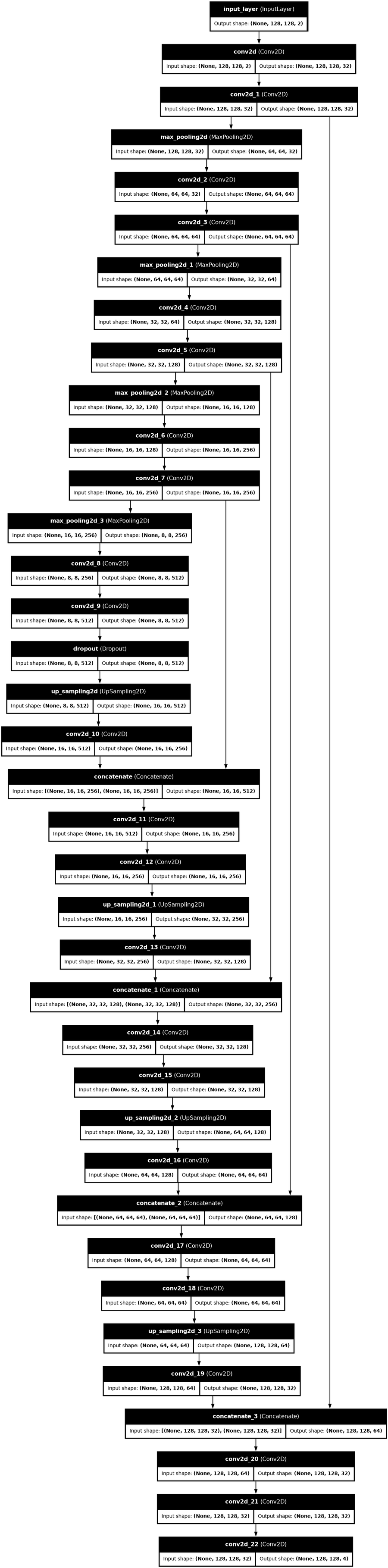
plot_model during training —
every layer with its exact tensor shapes. Scroll inside the frame, or click to open full size.How a critic changes what the U-Net optimises
The generator is unchanged. What changes is the loss: alongside cross-entropy it now receives a gradient from a network that has been trained to recognise expert annotations.
@tf.function-compiled step using two GradientTape contexts, with
separate Adam optimisers at lr 2×10⁻⁴,
β1 = 0.5.Why λ = 100
The generator's loss has two terms with very different scales. The adversarial term is a binary cross-entropy on a single sigmoid — order 1. The segmentation term is a categorical cross-entropy that, on a well-fit model, sits around 0.02. Left unweighted, the adversarial term would be ~50× louder and the generator would optimise for a critic-pleasing mask rather than a correct one.
λ = 100 restores the balance: cross-entropy stays the dominant signal and the adversarial term acts as a tie-breaker among pixel-equivalent solutions, nudging the generator toward the one that looks hand-drawn. This is the same weighting pix2pix uses for its L1 term, for the same reason.
@tf.function
def train_step(mri_images, real_masks):
    with tf.GradientTape() as gen_tape, tf.GradientTape() as disc_tape:
        fake_masks  = generator(mri_images, training=True)

        real_output = discriminator([mri_images, real_masks], training=True)
        fake_output = discriminator([mri_images, fake_masks], training=True)

        total_disc_loss = (bce_loss(tf.ones_like(real_output),  real_output)
                         + bce_loss(tf.zeros_like(fake_output), fake_output))

        gen_adv_loss = bce_loss(tf.ones_like(fake_output), fake_output)
        gen_seg_loss = cce_loss(real_masks, fake_masks)
        total_gen_loss = gen_adv_loss + (LAMBDA_SEG * gen_seg_loss)   # LAMBDA_SEG = 100

    generator_optimizer.apply_gradients(zip(
        gen_tape.gradient(total_gen_loss, generator.trainable_variables),
        generator.trainable_variables))
    discriminator_optimizer.apply_gradients(zip(
        disc_tape.gradient(total_disc_loss, discriminator.trainable_variables),
discriminator.trainable_variables))Three critics, three failure modes
This is the whole experiment. Same generator, same data, same epochs — only the critic changes. Two of the three configurations break, and both break for reasons that are visible in the architecture before a single epoch is run.
Layer stacks
Model D · 4×4, stride 2 champion
Concat(MRI, mask)      128²×6
Conv 4×4 s2   64      64²
LeakyReLU 0.2
Conv 4×4 s2  128      32²
LeakyReLU 0.2
Conv 4×4 s2  256      16²
LeakyReLU 0.2
Flatten                65,536
Dropout 0.3
Dense 1 sigmoid             1
727,489 parameters. 4 ÷ 2 = 2, so every interior column is seen by exactly two windows — symmetric feature extraction, no checkerboard. Dropout on the flattened vector keeps the critic from overpowering the generator early.
Model B · 3×3, stride 2 artefacts
Concat(MRI, mask)      128²×6
Conv 3×3 s2   64      64²
LeakyReLU 0.2
Conv 3×3 s2  128 +BN  32²
Conv 3×3 s2  256 +BN  16²
Conv 3×3 s1  512 +BN  16²
Conv 3×3 s1    1      16²
sigmoid  → verdict grid
1,560,897 parameters. Classic pix2pix shape with a smaller kernel — and 3 ÷ 2 = 1.5, so coverage alternates 2, 1, 2, 1 and the critic carries a period-2 spatial bias into every gradient.
Model C · 3×3, stride 1 the paradox
Concat(MRI, mask)      128²×6
Conv 3×3 s1   64      128²
MaxPool 2×2           64²
Conv 3×3 s1  128 +BN  64²
MaxPool 2×2           32²
Conv 3×3 s1  256 +BN  32²
MaxPool 2×2           16²
Conv 3×3 s1  512 +BN  16²
Conv 3×3 s1    1      16²
1,559,937 parameters (1,558,145 trainable). Bias-free convolutions,
N(0, 0.02) init. Stride 1 restores uniform coverage — and costs ~4× the
FLOPs, 211 min of training, and the study's worst global coherence.
The intended fix that backfired. Model C exists because Model B's 3×3/stride-2 kernel does not tile its input evenly. Stride 1 plus max-pooling removes that bias — but pooling also makes the critic locally translation-invariant, discarding exactly the positional information needed to judge whether a mask sits in the right place. Its discriminator loss climbed from 9.06 to 12.48 over 35 epochs instead of falling, and its SSIM became the worst in the study even as its local segmentation loss became the best. That is the PatchGAN Paradox. See the divergence in the training curves →
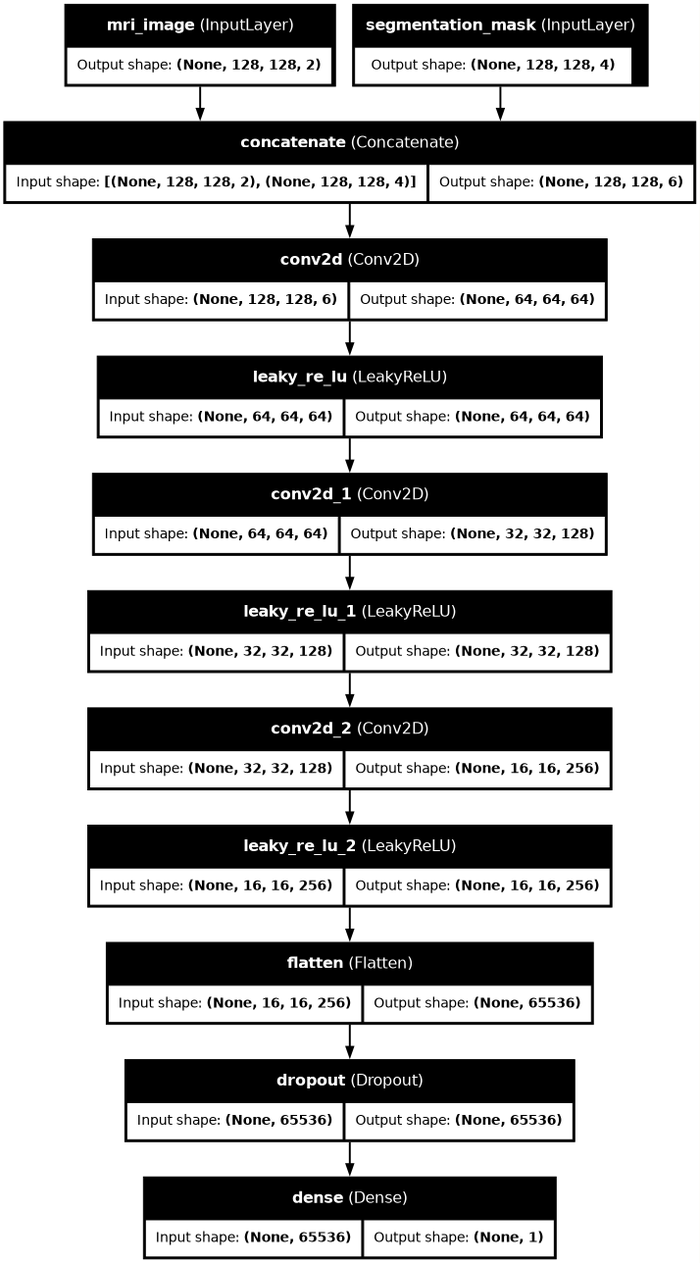
mri_image, segmentation_mask) join at the concatenate layer, pass through
three 4×4 stride-2 blocks and reduce to a single verdict. Note the implemented head is a
Flatten → Dense(1) global verdict rather than a patch grid;
the kernel/stride argument applies to the convolutional stack either way.Complete training configuration
| Setting | Model A (U-Net) | Models B / C / D (cGAN) |
|---|---|---|
| Input | 128×128×2 | 128×128×2 |
| Output | 128×128×4 softmax | 128×128×4 softmax |
| Generator params | 7,759,908 | 7,759,908 |
| Loss | categorical cross-entropy | BCE + 100 · CCE (G), BCE (D) |
| Optimiser | Adam | Adam ×2 (separate) |
| Learning rate | 1×10⁻³ | 2×10⁻⁴ |
| β1 | 0.9 (default) | 0.5 |
| LR schedule | ReduceLROnPlateau, factor 0.2, patience 2 | none |
| Epochs | 35 | 35 |
| Steps per epoch | 250 | 250 |
| Batch | 1 patient = 100 slices | 1 patient = 100 slices |
| Training loop | model.fit() | tf.GradientTape, custom |
| Checkpointing | best val_loss, weights only | generator weights every 5 epochs |
| Init | he_normal | he_normal (G), varies (D) |
Environment: Kaggle GPU notebooks, TensorFlow with Keras 3, Python 3.10. Every value above is read directly from the notebook source — browse the runs to see it in context.